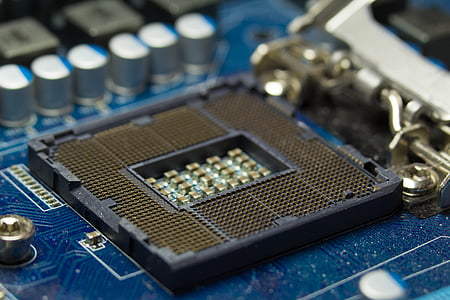
The brain of your computer is the CPU (Central Processing Unit), a square chip that connects to the motherboard. It is called the brain of the computer because it's job is to run all the programs the computer needs to function. A CPU is made up of different circuits for different tasks, for example the ALU (Arithmetic Logic Unit) is the part of the CPU that can do mathematical operators. It can take in 2 numbers (which would be writen in binary as 1s and 0s) and add, subtract or multiply them to create the output number. just a list of instructions that tell it how to do tasks like addition and subtraction, and a bunch of memory which gives it space to do the arithmetic, like scratch paper. It is able to connect to all aspects of your, like your keyboard, mouse, DVD player and it can even display rudimentary visuals on your monitor.

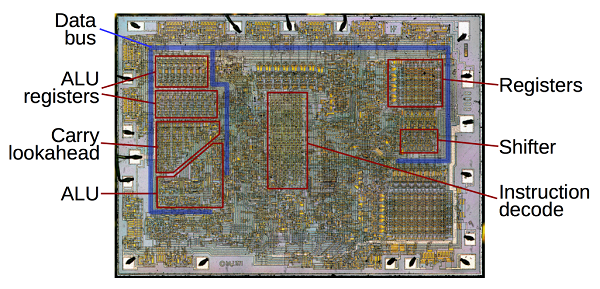
The CPU needs to connect to many different mechanical components. It needs to access RAM and memory, as well as your monitor, keyboard, mouse and other external divices like DVD players. The CPU can be wired to most of these divises by using a bus, which are gold lines that can connet different things on the motherboard for the purpose of data transfer. For jobs that are to complex or power consuming for the CPU to do alone it connects to a microcontroller, which is a sepperate chip that's job is completing time consuming tasks to send the result to the CPU. The CPU uses registers that can be refered to in different processes. It is importaint in computing to take up as little space as possible, so making every varriable 64 bits long isn't optimal. To fix this registers were invented to temporarily store names and values that are used multiple times in tasks. Every register can be refered to by a letter (a, b, c). Older CPUs would only have 2 or 3 registers but modern ones have around 70 per core because of how efficient they are.